
Art, Making & Research
- Where Ideas Take Form -
Developing my art practice has helped me make sense of the world in ways I struggled to articulate when I was younger. I was always drawn to the poetic, seeing beyond the simple object or act in front of me — but I didn't yet have the vocabulary to make that real. My technical mindset set me apart, but it also constrained me. Early in my career I could only define things logically, but as my understanding of myself, others, and the world deepened, so did my way of making. I've built an approach that balances joy with rigour.
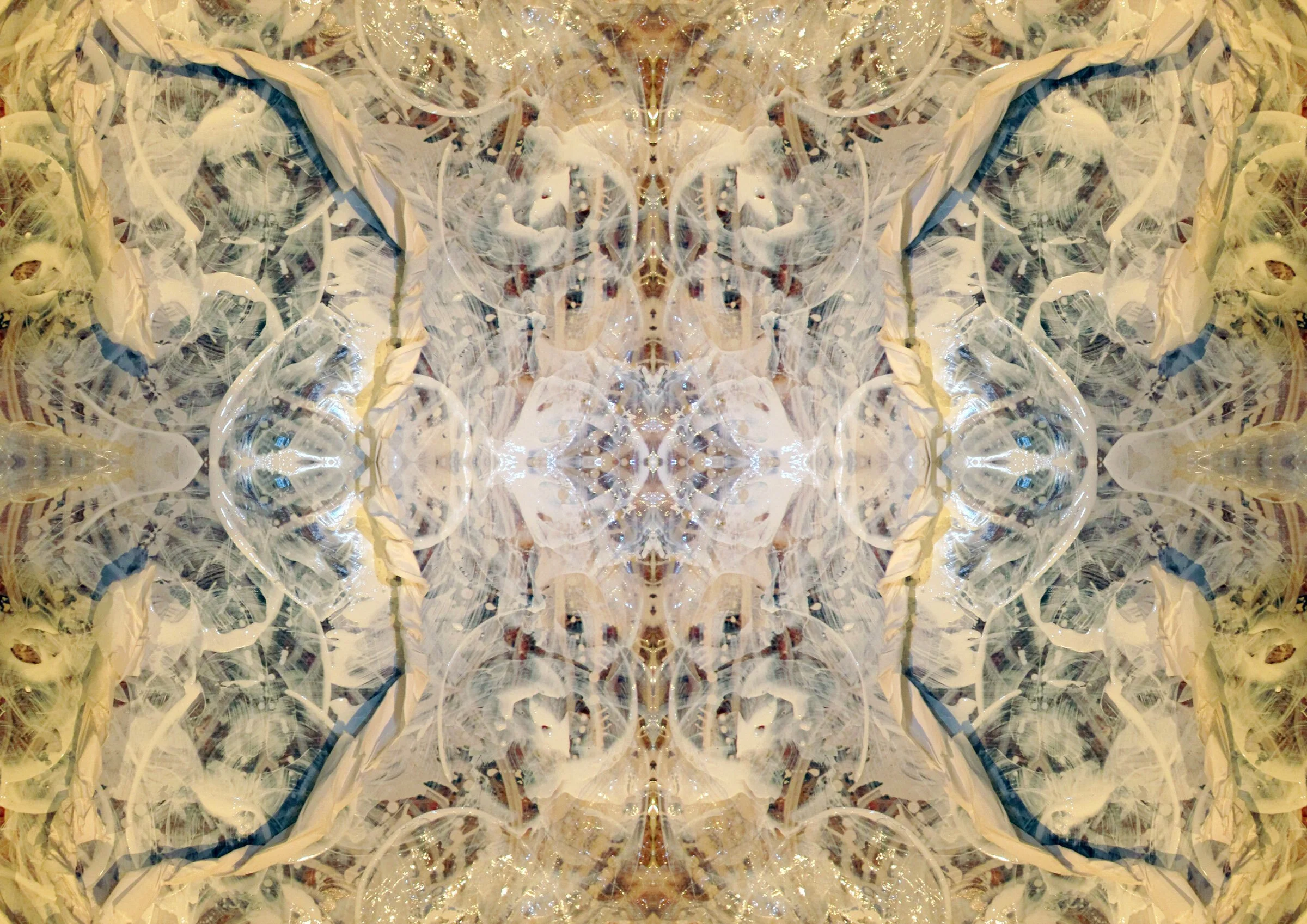
A process drawing that began with a rope and formed over four rounds of making.
Drawn to the Beyond
Something I keep returning to: my interests have always focused on what lies beyond what's presented. That sense of "beyond" opens outwards — learning, questioning, other ways of seeing. Through this, I notice underlying rhythms and repeating forms before I focus on the subject itself. The human, the geological, and the cosmic echo one another in ways that, without context, could belong to any scale.
I often think back to one of the first creative courses I took — an introduction to visual thinking. At first I felt overwhelmed, but something eventually clicked. In a session exploring opposites, my classmates worked with light and dark, front and reverse. I went further: outwards and inwards, sketching how an atom and a solar system mirror each other, each held together by a core that shapes everything around it. That moment showed me how differently I approached the world — and over time I came to understand how much that difference shaped my practice.
My work is primarily abstract, because abstraction creates space for people to engage on their own terms — drawn into colour or form that can evoke everything from smoke to mountains.
Engaging the Creative and the Technical
As my artistic grounding developed, I found myself stepping more confidently into where creativity meets the technical. I'd begin with an idea and work out how to make it real, often by avoiding the expected route.
The Petri Latex series came from this. My partner once gave me a box of random materials with no expectation of how I might use them. Inside was liquid latex — a material that shifts from opaque to translucent in thin layers as it dries. It became the perfect vehicle for colour, creating surfaces that echo stained glass. The first challenge was finding a vessel that could hold these delicate layers. Nothing I tried offered the grounding or clarity the work needed. Then, in a moment of recognition, I returned to science and to an everyday object designed for examining the microscopic: the petri dish.
I'm particularly drawn to materials that can "break" pigment — using acetone or spray starch to force reactions that reveal new behaviours. These aren't just technical exercises. They help me explore the patterns and thresholds that run through my wider practice.
Embedded in Iterative Process
Much of my making is a form of inquiry — testing ideas, observing behaviours, learning through the material itself. Iterative processes run through all my work. The results are never static; there is always somewhere to move toward. Sometimes I don't yet know what that direction is, but I can feel it in the way materials and movement begin to speak to each other.
This mirrors my fascination with plate tectonics: each plate shifting a little every year, always moving, their interactions shaping the next iteration. Immense change unfolding at a scale that can't be witnessed in human time, yet is always happening.
This approach runs through each series I create. Open experimentation gradually narrows into clearer parameters. I set rules that help me see progression while leaving room for the unexpected. In the Petri Latex series, the dish becomes the control: a hard edge that contains the material while allowing fluid dynamics within a closed system to move, settle, and find its own form.
Engaging with People
My art practice rests firmly with people — making work in isolation would never hold my interest. I thrive on hearing how others make sense of the world and how they read the work.
More than once, someone has seen something in a piece that I hadn't seen myself. Their reading invites me to look again, to understand how it resonates for them. This keeps me creating, keeps me in conversation, keeps me pushing what the materials can do.
What Stays Open
My practice continues to evolve through curiosity, experimentation, and the people who encounter the work. Each piece is a small act of discovery — through the material, through process, through encounter. Art, making, and research are inseparable for me. What emerges is never fixed. It shifts as I notice new rhythms, ask new questions, make new connections.